No. 6, August 2026

Authors

The DALIA Team

13.08.2026

New Features on the DALIA Platform

User Login

We are delighted to announce that the DALIA platform now also provides a user login. To seamlessly fit into the NFDI cosmos, we implemented the login together with the Base4NFDI service IAM4NFDI in an incubator project. Users can now log in to DALIA via their home institutions or via ORCID. Curious? Try it out and log in yourself: Login

Please use the IAM4NFDI login (1) and choose your community or guest access (2). Afterwards, you can choose to log in via your home institution or ORCID (3). This way, you won’t need a separate username and password for DALIA.
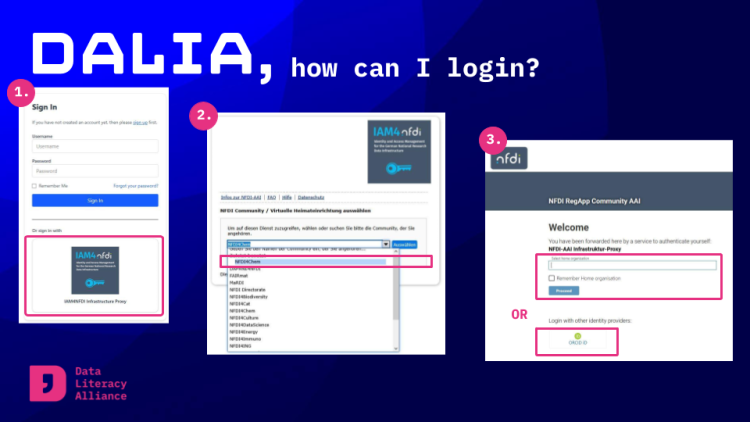
Step by step login procedure for IAM4NFDI login to the DALIA portal. Please use the IAM4NFDI login.

Once logged in, users can use the curation form to submit new resources to DALIA (see below). In addition, features such as “Like” and “Bookmark“ are available. Resources marked in this way can be viewed as a list in your profile under “My Activities.”

Curation Form - Registering New Resources

Do you have an open educational resource (OER) on data literacy that would fit perfectly into the portfolio of DALIA? You can use our curation form, which you can find in your user profile under “Add Content”, to register the resource. As DALIA is only a registry, the repository must be a different platform (e.g. Zenodo). Entering the metadata necessary for the registration of OER in accordance with the DALIA Interchange format (DIF) is now more user-friendly thanks to the provision of picklists to choose from. Furthermore, our FAIRness score will motivate content providers to include as much metadata as possible. All information provided beyond mandatory will increase the FAIRness score as OERs can only be used if they are findable.
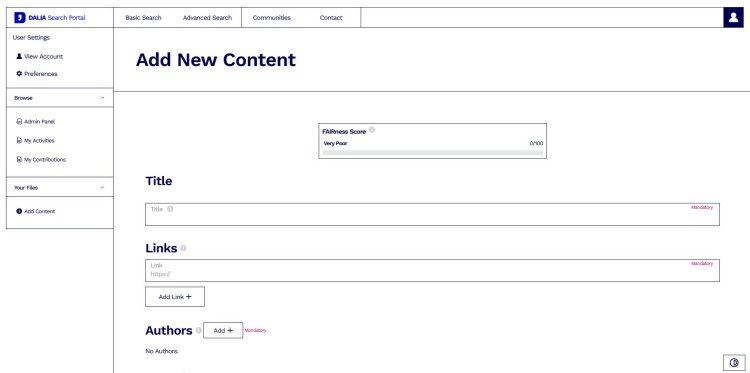
The DALIA curation form.

The fields in the curation form are either free-text fields or contain drop-down lists to ensure that terms are as consistent as possible, as specified in the DALIA Interchange Format. For the “Community” field, you can create new entries if the desired community does not yet exist in the list.

After submission of the form, the entry will be reviewed by our curators to ensure the quality of the metadata sets. Once reviewed, the entry for the new resource will be published online.

If you have extensive resource collections that you would like to submit in tabular form, please use the CSV template we provided with the DIF Version 1.3. You can email your submissions to contact@dalia.education.

We look forward to receiving new contributions for DALIA from the community!

DALIA Publications

New Publication in Springer Nature Computer Science

How do you teach research data management (RDM) to students? At the RWTH Aachen University, chemistry students document experiments using the open-source Chemotion ELN and develop data literacy through DALIA, while gaining practical RDM skills in the lab. Check out the publication.
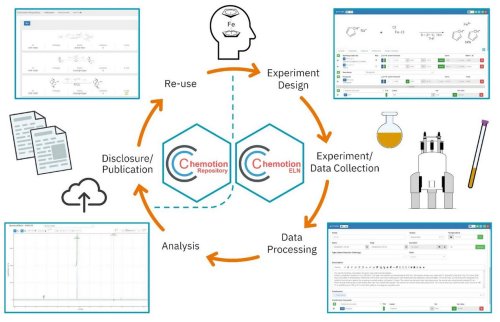
Chemotion: Data lifecycle realized in Chemotion as an electronic laboratory notebook and as a repository.

Shaping User Personas for NFDI Section Training & Education and DALIA

DALIA aims to make teaching materials on data literacy easier to discover, access, and reuse across disciplines and educational contexts. Because our audience ranges from learners and lecturers to researchers with varying levels of RDM expertise, the NFDI Section Training & Education and DALIA developed a set of user personas to support user‑centered design. This paper outlines the persona development process and presents the resulting profiles, which provide a practical framework for designing and improving training infrastructures and educational offerings within the NFDI ecosystem. Read the publication.
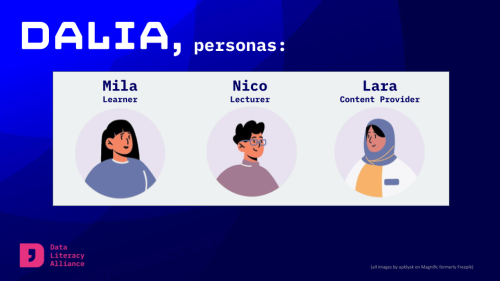
The three personas: Mila Learner, Nico Lecturer and Lara Content Provider.

DALIA Interchange Format (DIF), Glossary for Open Educational Resources (GlossOER), and MoDALIA Ontology

The metadata describing resources in DALIA must be defined and structured. Our efforts have resulted in three compatible knowledge organization systems: DIF, GlossOER and MoDALIA.

DALIA Interchange Format (DIF) Version 1.4

The DALIA Interchange Format (DIF) provides a framework for making the metadata and controlled vocabulary of teaching and learning materials transparent, comparable and easy to integrate into the DALIA platform. Developed by the DALIA project within the context of the German National Research Data Infrastructure (NFDI), it ensures that educational resources retrievable on the platform are interoperable and maintains a high quality regarding the findability. After publication of version 1.3 of the DIF, the DALIA team received a lot of constructive feedback from the community. This feedback served as the foundation for the revised version of the DIF (version 1.4) which is now available on Zenodo.

GlossOER

The Glossary for Open Educational Resources (GlossOER) provides a structured vocabulary for the metadata of open educational resources (OERs). It accompanies the DALIA Interchange Format (DIF), and the ontology MoDALIA. However, GlossOER also includes vocabulary items and usage examples not found in DIF version 1.4 or MoDALIA. The GlossOER publication is available on Zenodo.

MoDALIA

We developed MoDALIA, an OWL ontology that serves as the semantic backbone of the DALIA teaching, learning, and recommendation platform for Research Data Management (RDM) and data literacy. The ontology structures the metadata of learning resources according to properties such as media type, resource category, covered topics, target audience, and required competency level. This enables DALIA to recommend suitable materials based on specific learning objectives.

MoDALIA follows a modular design and is interoperable with existing standards such as schema.org and AMB. The ontology adheres to the FAIR principles: It has a persistent URL, a defined license, links to Linked Open Data vocabularies, and is publicly available with accompanying documentation. For more information, visit MoDALIA or refer to the Zenodo publication.

All three knowledge organization systems were presented at various events, including the E-Science-Tage 2025, the NFDITalk, the Digital Humanities Conference 2025 (DH2025), the 2nd Conference on Research Data Infrastructure (CoRDI), the NFDI4ING Conference 2025, and the 12. Jah­res­ta­gung des Verbands Digital Humanities im deutschsprachigen Raum e.V. (DHd2026).

DALIA Events

Workshop at Dhd2026 - Context and clarity: Subject-specific metadata for open educational resources (OER) on data literacy

How can Open Educational Resources be described in a standardised way? This was the central question addressed by participants at a workshop held at DHd2026 in Vienna, organised by the HERMES, NFDI4Memory, DALIA and NFDI4Culture projects. Working in small groups, the participants identified some interesting insights. Continue reading.

No. 6, August 2026

Autoren

The DALIA Team

13.08.2026

New Features on the DALIA Platform

User Login

We are delighted to announce that the DALIA platform now also provides a user login. To seamlessly fit into the NFDI cosmos, we implemented the login together with the Base4NFDI service IAM4NFDI in an incubator project. Users can now log in to DALIA via their home institutions or via ORCID. Curious? Try it out and log in yourself: Login

Please use the IAM4NFDI login (1) and choose your community or guest access (2). Afterwards, you can choose to log in via your home institution or ORCID (3). This way, you won’t need a separate username and password for DALIA.

Step by step login procedure for IAM4NFDI login to the DALIA portal. Please use the IAM4NFDI login.

Once logged in, users can use the curation form to submit new resources to DALIA (see below). In addition, features such as “Like” and “Bookmark“ are available. Resources marked in this way can be viewed as a list in your profile under “My Activities.”

Curation Form - Registering New Resources

Do you have an open educational resource (OER) on data literacy that would fit perfectly into the portfolio of DALIA? You can use our curation form, which you can find in your user profile under “Add Content”, to register the resource. As DALIA is only a registry, the repository must be a different platform (e.g. Zenodo). Entering the metadata necessary for the registration of OER in accordance with the DALIA Interchange format (DIF) is now more user-friendly thanks to the provision of picklists to choose from. Furthermore, our FAIRness score will motivate content providers to include as much metadata as possible. All information provided beyond mandatory will increase the FAIRness score as OERs can only be used if they are findable.

The DALIA curation form.

The fields in the curation form are either free-text fields or contain drop-down lists to ensure that terms are as consistent as possible, as specified in the DALIA Interchange Format. For the “Community” field, you can create new entries if the desired community does not yet exist in the list.

After submission of the form, the entry will be reviewed by our curators to ensure the quality of the metadata sets. Once reviewed, the entry for the new resource will be published online.

If you have extensive resource collections that you would like to submit in tabular form, please use the CSV template we provided with the DIF Version 1.3. You can email your submissions to contact@dalia.education.

We look forward to receiving new contributions for DALIA from the community!

DALIA Publications

New Publication in Springer Nature Computer Science

How do you teach research data management (RDM) to students? At the RWTH Aachen University, chemistry students document experiments using the open-source Chemotion ELN and develop data literacy through DALIA, while gaining practical RDM skills in the lab. Check out the publication.

Chemotion: Data lifecycle realized in Chemotion as an electronic laboratory notebook and as a repository.

Shaping User Personas for NFDI Section Training & Education and DALIA

DALIA aims to make teaching materials on data literacy easier to discover, access, and reuse across disciplines and educational contexts. Because our audience ranges from learners and lecturers to researchers with varying levels of RDM expertise, the NFDI Section Training & Education and DALIA developed a set of user personas to support user‑centered design. This paper outlines the persona development process and presents the resulting profiles, which provide a practical framework for designing and improving training infrastructures and educational offerings within the NFDI ecosystem. Read the publication.

The three personas: Mila Learner, Nico Lecturer and Lara Content Provider.

DALIA Interchange Format (DIF), Glossary for Open Educational Resources (GlossOER), and MoDALIA Ontology

The metadata describing resources in DALIA must be defined and structured. Our efforts have resulted in three compatible knowledge organization systems: DIF, GlossOER and MoDALIA.

DALIA Interchange Format (DIF) Version 1.4

The DALIA Interchange Format (DIF) provides a framework for making the metadata and controlled vocabulary of teaching and learning materials transparent, comparable and easy to integrate into the DALIA platform. Developed by the DALIA project within the context of the German National Research Data Infrastructure (NFDI), it ensures that educational resources retrievable on the platform are interoperable and maintains a high quality regarding the findability. After publication of version 1.3 of the DIF, the DALIA team received a lot of constructive feedback from the community. This feedback served as the foundation for the revised version of the DIF (version 1.4) which is now available on Zenodo.

GlossOER

The Glossary for Open Educational Resources (GlossOER) provides a structured vocabulary for the metadata of open educational resources (OERs). It accompanies the DALIA Interchange Format (DIF), and the ontology MoDALIA. However, GlossOER also includes vocabulary items and usage examples not found in DIF version 1.4 or MoDALIA. The GlossOER publication is available on Zenodo.

MoDALIA

We developed MoDALIA, an OWL ontology that serves as the semantic backbone of the DALIA teaching, learning, and recommendation platform for Research Data Management (RDM) and data literacy. The ontology structures the metadata of learning resources according to properties such as media type, resource category, covered topics, target audience, and required competency level. This enables DALIA to recommend suitable materials based on specific learning objectives.

MoDALIA follows a modular design and is interoperable with existing standards such as schema.org and AMB. The ontology adheres to the FAIR principles: It has a persistent URL, a defined license, links to Linked Open Data vocabularies, and is publicly available with accompanying documentation. For more information, visit MoDALIA or refer to the Zenodo publication.

All three knowledge organization systems were presented at various events, including the E-Science-Tage 2025, the NFDITalk, the Digital Humanities Conference 2025 (DH2025), the 2nd Conference on Research Data Infrastructure (CoRDI), the NFDI4ING Conference 2025, and the 12. Jah­res­ta­gung des Verbands Digital Humanities im deutschsprachigen Raum e.V. (DHd2026).

DALIA Events

Workshop at Dhd2026 - Context and clarity: Subject-specific metadata for open educational resources (OER) on data literacy

How can Open Educational Resources be described in a standardised way? This was the central question addressed by participants at a workshop held at DHd2026 in Vienna, organised by the HERMES, NFDI4Memory, DALIA and NFDI4Culture projects. Working in small groups, the participants identified some interesting insights. Continue reading.