original publication, see here
Digital tools and working with research data are transforming everyday academic life—and require the development of new skills. Data literacy (Schüller, Busch and Hindinger, 2019) and research data management (RDM) play a particularly important role in this context, and can be taught through OER (Open Educational Resources) (Deimann et al., 2015). However, OER on RDM are currently scattered across various platforms and are therefore difficult to find. Platforms such as DALIA (Ortmeyer et al., 2024) or collections such as NFDI4Memory HISTOCAT and HERMES Resourcebase are attempting to remedy this through registries and curated collections. A key factor in the discoverability and reusability of OER, however, is good metadata—yet existing schemas (e.g. the schema of the HERMES Data Competence Centre (Urbaum et al., 2026) or the DALIA Interchange Format (Geiger et al., 2026)) differ in terms of subject-specific details such as disciplines or methods. In many cases, standardised vocabularies for describing OER are lacking, which would make search and retrieval processes more efficient.
Against this thematic backdrop, the projects HERMES, NFDI4Memory, DALIA and NFDI4Culture organised a workshop at the 12th annual conference of the Association for Digital Humanities in the German-speaking World (DHd2026), which took place from 23 to 27 February 2026 at the University of Vienna. The conference in Vienna was held under the motto “Not just text, not just data”, thereby broadening its focus from traditional text-based analyses to a comprehensive, cross-object perspective. In addition to text corpora, the focus now also included people, places, material culture, image and sound objects, climate data, and genetic and neurophysiological measurements.
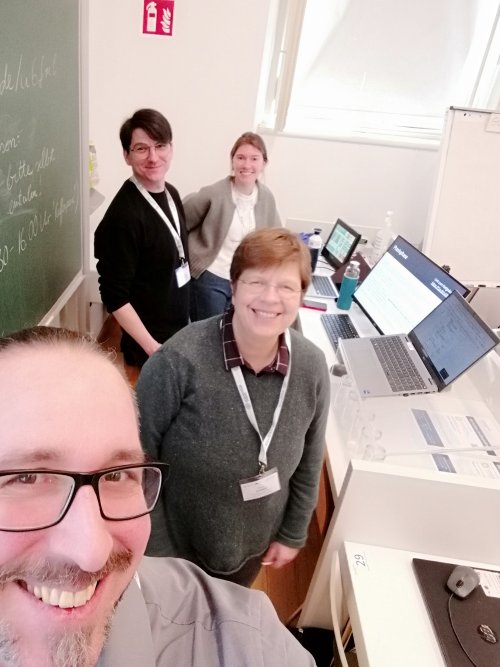
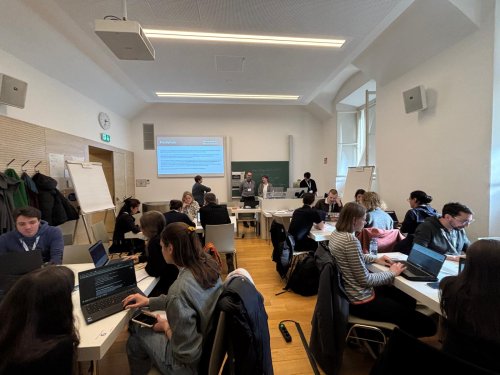
In particular, the technical interest shown by conference participants and the breadth of the humanities disciplines represented made the DHd conference a suitable venue for the workshop “Context and Clarity: Subject-Specific Metadata for Open Educational Resources (OER) on Data Literacy”. Our aim was to examine metadata schemas and subject-specific metadata of OER in detail, thereby developing a basis for improving the schemas. The half-day workshop therefore focused on the analysis and structuring of OER metadata—in particular the use of subject-specific, controlled vocabularies, picklists and metadata schemas for humanities teaching and learning materials. A brief introduction to the speakers and their projects was followed by an ice-breaker that addressed the ambiguity of classifications. The subsequent concise introduction provided an overview of our area of investigation, including OER metadata standards, metadata schemas, vocabularies, and their disciplinary challenges and potential. During the group phase, the Think-Pair-Share method developed by Bönsch (2002) was used. In the main part of the session, participants worked in small groups through a classic resource discovery process. Using selected OER from various humanities disciplines, the participants examined the extent to which the two OER metadata schemas from HERMES and DALIA were suitable for the resources and to what extent discipline-specific information could be provided regarding the values of the individual attributes. The workshop lead team provided support throughout. Finally, the results were presented in a plenary session, needs were discussed, and next steps for the further development of picklists were outlined. A reflection session summarised key findings and identified areas for further work.
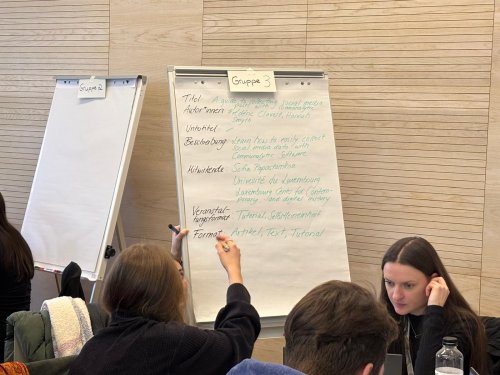
There were some interesting overlaps in the small groups’ feedback: according to their comments, author and licence information for the resources was often unclear or missing entirely; target audiences and proficiency levels were described inconsistently or were not clearly distinguished from one another. Both metadata schemas contained redundancies or too many mandatory fields, and metadata fields such as title, subtitle or version details could not be specified consistently. Participants also noted that adaptability to subject-specific terminology is currently still limited. These overlaps gave rise to joint recommendations: a modular core/extension approach was proposed, in which basic metadata is mandatory and subject-specific fields can be added optionally via controlled vocabularies (picklists). Furthermore, it was suggested that licence and author details for OER be clearly indicated; that the disciplinary taxonomy be expanded to include the digital humanities; and that meta-metadata (version, date, provenance, authors, etc.) be systematically integrated. For more complex cases, the option of free additions was also considered useful. Standardised definitions for OER, clear role descriptions and a tiered competency model were likewise deemed desirable. During the group discussion, particular emphasis was placed on the importance of metadata for versioning and the traceability of developments.
The workshop leads would like to extend their sincere thanks to all participants for their lively and productive involvement, and to the DHd for hosting the conference in Vienna. The workshop has also provided us with many ideas that will inform the further development of our work on metadata and platforms. The substantive work on OER and metadata is to be continued within the framework of a DHd working group on data literacy—interested parties are warmly invited to get involved and can subscribe to the mailing list and/or join our RocketChat channel (OER.Net).
References
- Bönsch, Manfred. 2002. Unterrichtsmethoden – kreativ und vielfältig. Schneider-Verlag Hohengehren.
- Deimann, Markus, Jan Neumann und Jöran Muuß-Merholz. 2015. Whitepaper Open Educational Resources (OER) an Hochschulen in Deutschland – Bestandsaufnahme und Potenziale 2015. Transferstelle für OER. Hamburg. https://open-educational-resources.de/wp-content/uploads/Whitepaper-OER-Hochschule-2015.pdf (zugegriffen: 26.03.2026).
- Geiger, Jonathan, Petra Steiner, Abdelmoneim Amer Desouki, Henrika Maria Hüppe und Frank Lange. 2026. DALIA Interchange Format (1.4). DOI: 10.5281/zenodo.17871138
- Ortmeyer, Jochen, Jan-Michael Haugwitz, Petra Steiner, Thomas Stäcker, Torsten Schrade, Ulrich Sax, Gábor Kismihók, Matthias Müller, Peter F. Pelz und Sonja Herres-Pawlis. 2024. A Platform for the Provision of Teaching and Training Contents in Data Literacy: DALIA4NFDI. BASE4NFDI User Conference. Berlin, 20-21 November 2024. DOI: 10.5281/zenodo.14183168
- Schüller, Katharina, Paulina Busch und Carina Hindinger. 2019. Future Skills: Ein Framework für Data Literacy. Hochschulforum Digitalisierung, 47. DOI: 10.5281/zenodo.3349865
- Urbaum, Dorothee und Grigori Chlesberg. 2026. Metadatenschema und Picklisten für Open Educational Resources des Datenkompetenzzentrums HERMES – Humanities Education in Research, Data, and Methods (v1-1). DOI: 10.5281/zenodo.18679758
- Urbaum, Dorothee, Laura Döring, Grigori Chlesberg, Jonathan D. Geiger und Petra Steiner. 2026. Kontext und Klarheit: Fachspezifische Metadaten für offene Bildungsressourcen (OER) zu Data Literacy. In: Silke Schwandt, Gabriel Viehhauser, Tara Andrews und Thomas Wallnig (Hg). 2026. Book of Abstracts - DHd 2026: Nicht nur Text, nicht nur Daten. 12. Jahrestagung des Verbands Digital Humanities im deutschsprachigen Raum e.V. DHd2026, Universität Wien, 23.–27. Februar 2026. Wien. DOI: 10.5281/zenodo.18702757
Authors
- Laura Döring, Universität Trier, doeringl@uni-trier.de, https://orcid.org/0009-0001-7129-2018
- Grigori Chlesberg, Herder-Institut für historische Ostmitteleuropaforschung - Institut der Leibniz-Gemeinschaft, grigori.chlesberg@herder-institut.de, https://orcid.org/0009-0000-9036-2723
- Dorothee Urbaum, Hochschule Darmstadt, dorothee.urbaum@h-da.de, https://orcid.org/0009-0003-5711-6303
- Jonathan D. Geiger, Akademie der Wissenschaften und der Literatur Mainz, jonathan.geiger@adwmainz.de, https://orcid.org/0000-0002-0452-7075
- Petra Steiner, Technische Universität Darmstadt, petra.steiner@tu-darmstadt.de, https://orcid.org/0000-0001-8997-2620